Colored contact lenses are not simply a color choice; they are medical devices whose comfort and performance depend on materials, design, and proper fitting. For global buyers, choosing a colored contact lens manufacturer means looking beyond attractive product photographs and broad promises. Details matter.
A careful comparison should examine lens materials, available prescriptions, base curves, diameters, color consistency, and manufacturing controls. Buyers can request product specifications, quality documentation, sample lots, and clear answers about traceability and packaging. They should also confirm that product claims and labeling meet the requirements of each intended market, with qualified local guidance where needed. These checks do not guarantee a perfect partnership, but they make important gaps easier to spot.
This guide explores manufacturers through practical criteria, including production capability, communication, customization, and support after delivery. A polished catalog is useful, yet it cannot show how reliably a supplier handles a delayed sample or a color variation between batches. Ask direct questions, compare written responses, and verify claims rather than relying on sales language alone. The process can be untidy. Some details may remain uncertain until samples and records are reviewed. That is a reason to investigate carefully, not to assume every supplier is unsuitable. The goal is to help buyers make informed comparisons and build sourcing relationships grounded in evidence, product quality, and wearer safety.
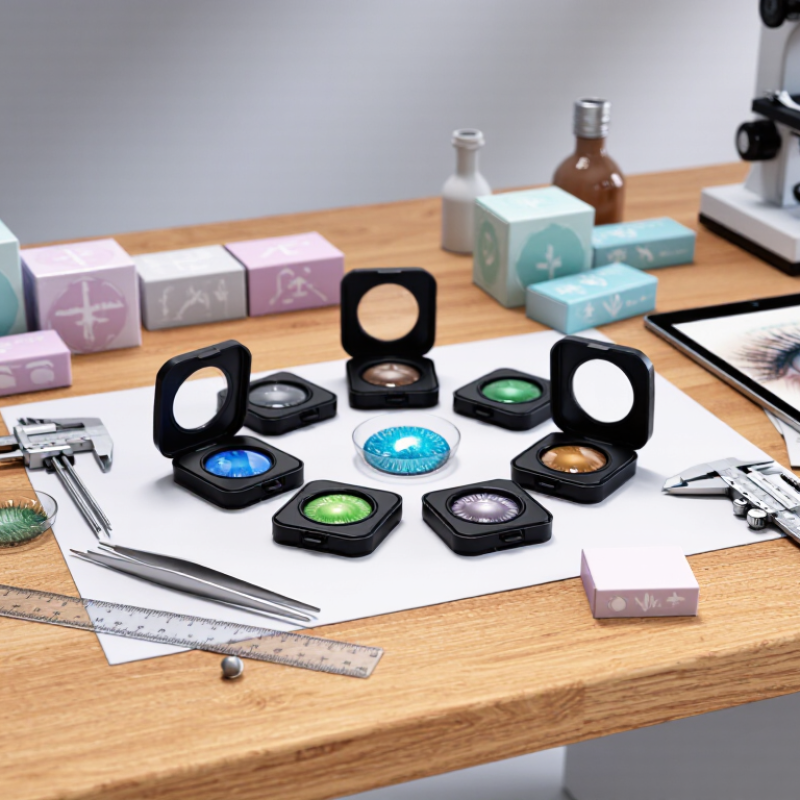
Colored contact lenses range from subtle enhancement tints to opaque colors designed to change the appearance of darker irises. Some are clear lenses with a light tint for handling, while others add visible color. Daily and reusable formats serve different routines. Short wear can suit an event; regular wear calls for consistent care and professional fitting.
Uses vary, but comfort and vision needs should guide selection. The same shade may look different under office lighting and bright daylight, especially across different natural eye colors. For global buyers, the market includes cosmetic and prescription options, with demand shaped by product quality, material choices, packaging, and regional preferences. Manufacturers should provide clear specifications and quality documentation. A polished sample is not enough; production consistency can be harder to judge.
Tips: Confirm lens diameter, base curve, material, and replacement schedule with an eye-care professional. Request samples and inspect color under more than one light source. Ask suppliers how they verify batch consistency. Small details matter. Don’t treat decorative lenses as one-size-fits-all.
A reliable colored contact lens manufacturer should be assessed on more than shade range and price. Ask for current quality-system certificates, traceable production records, and test results for each lens design. Check whether specifications cover oxygen permeability, water content, dimensions, surface quality, and color-layer stability. Request samples from regular production, not specially prepared units. Then compare printed specifications with independent laboratory results. Small inconsistencies matter.
Safety deserves close attention. A CDC analysis published in 2015 estimated nearly one million U.S. outpatient and emergency visits for keratitis each year, with contact lenses among the relevant risk factors. That figure is not specific to colored lenses, but it shows why manufacturing controls cannot be treated as paperwork. Review complaint handling, batch traceability, and procedures for investigating defects. Ask how the manufacturer tests lenses after storage and shipping, too. A neat certificate is not the whole story.
Use ISO 18369, the international contact-lens standards series, as a reference when reviewing terminology and test methods; it does not replace product-specific verification. Request the exact test method, sample size, and report date. Compare these details across suppliers. If answers are vague, pause. I would also check how quickly technical staff respond to a practical question, such as a color-layer change after repeated wear. This is useful evidence, though not proof of consistent quality.
| Evaluation Dimension | What to Request | How to Evaluate | Buyer Record |
|---|---|---|---|
| Market Authorization | Documentation showing that the manufacturer and the specific lens products meet the requirements of each intended destination market. | Confirm the issuing authority, product scope, legal manufacturer, validity, and any conditions. Requirements differ by country; one authorization does not establish worldwide market access. | Target markets, authorization references, expiry or review dates, and responsible regulatory contact. |
| Quality Management System | A current quality-management certificate, such as ISO 13485 where applicable, plus its scope and covered manufacturing sites. | Check the certificate against the issuing body and confirm that its scope covers the relevant activities and site. A quality-system certificate alone is not product-market authorization. | Certificate scope, covered sites, issuing body, and verification date. |
| Product Classification and Claims | Product classification, intended use, labeling claims, and the regulatory basis for selling each lens in the target market. | Check that claims and classification match local rules. Decorative lenses may still be regulated as medical devices in some markets, even when they have no vision correction. | Intended use, classification, applicable rules, and required local registrations. |
| Lens Specifications | Specifications for material, water content, base curve, diameter, available powers, replacement schedule, and manufacturing tolerances. | Compare the technical file, product labeling, and sample measurements. Confirm that the offered parameters suit the intended users and comply with destination-market requirements. | Approved specification sheet, tolerances, sample results, and version date. |
| Color and Design Consistency | Color options, print or pigment details, design samples, and information about controls used to maintain appearance between production lots. | Review finished-lens samples under consistent lighting and compare samples from more than one lot. Confirm that color and design claims are supported by the product documentation. | Reference samples, approved color standards, lot comparison results, and change-control process. |
| Safety and Performance Evidence | Applicable biocompatibility, safety, and performance evidence for the specific lens material, design, and intended use. | Check that reports identify the relevant product or representative product family, use appropriate methods, and support the claims made for the target market. | Report titles, tested product scope, test dates, and any limitations. |
| Manufacturing and Sterilization Controls | Information on production controls, lot traceability, sterilization method, and validation or monitoring records where applicable. | Review how the manufacturer links finished products to production records and handles process changes. Confirm that sterilization evidence applies to the supplied product and packaging configuration. | Site and process details, traceability example, sterilization evidence, and change-control contacts. |
| Packaging and Labeling | Packaging specifications, shelf-life support, instructions for use, lot identification, and proposed labels for each sales market. | Check that labels and instructions meet local language and content requirements and agree with the authorized product specifications. Review packaging integrity and storage conditions. | Market-specific label proofs, packaging details, shelf-life evidence, and approval status. |
| Complaint and Recall Readiness | Documented processes for complaints, adverse-event escalation, product investigations, corrective actions, and recalls. | Ask how issues are recorded, investigated, escalated, and communicated to customers and relevant authorities when required. | Named contacts, escalation route, sample procedure, and record-retention details. |
| Supply Capability | Production capacity, minimum order quantities, quoted lead times, sample availability, and contingency plans. | Compare written commitments with a pilot order and ask how capacity, raw-material availability, and seasonal demand affect delivery. | Quoted MOQ, lead time, pilot-order results, capacity assumptions, and backup plan. |
| Customization and Change Control | Available options for colors, parameters, packaging, and private-label work, together with artwork and product-change procedures. | Clarify who approves changes, who owns supplied artwork or tooling, and whether a change could affect product documentation or market authorization. | Customization scope, ownership terms, approval steps, and change-notification process. |
| Supplier Verification | References, site details, sample documentation, and permission to conduct an appropriate remote or on-site assessment. | Cross-check company and site information against submitted documents. Resolve inconsistencies before committing to a commercial order. | Verification steps completed, open questions, assessment findings, and follow-up actions. |
| Comparison note: Evaluate each manufacturer against the requirements of the specific destination market and product. Request current, product-specific evidence; do not treat a certificate, sample, or marketing statement as a substitute for required regulatory authorization. | |||
For global buyers, a useful manufacturer profile explains how colored contact lenses are developed, produced, and checked. Leading manufacturers typically describe their lens materials, available color patterns, prescription options, and production capacity. These details help buyers compare suppliers beyond catalog photographs. A printed color sample can look different from a lens viewed under bright retail lighting. Details matter.
A strong profile also explains quality controls in practical terms. Buyers can ask how incoming materials are inspected, how production batches are tracked, and what records accompany shipments. Clear answers make supplier evaluation more dependable. Some manufacturers offer custom packaging or support for different order volumes, but minimum quantities and lead times should be confirmed in writing. Small print counts.
Communication is another useful measure. A responsive supplier should answer technical questions, provide current product specifications, and explain how product changes are reported. Buyers should review applicable documentation and verify that products meet requirements in their intended markets. A polished profile alone cannot establish product quality. It may leave gaps. Comparing written specifications with samples and records takes extra time, yet it can reveal differences that a sales presentation does not show. Manufacturers that state their capabilities—and their limits—give buyers a more realistic basis for long-term planning.
For global buyers, colored lens suppliers should be compared on measurable quality, documented compliance, and practical customization—not sample appearance alone. Grand View Research estimated the global contact lens market at US$20.4 billion in 2023, signaling a crowded, fast-moving supply chain. CDC reporting has estimated about 45 million U.S. contact lens wearers. Scale matters, but it does not prove consistent production.
Request test records for power, base curve, diameter, water content, and oxygen transmissibility. Ask how pigment is contained and how finished batches are inspected. ISO 18369 provides a relevant framework for contact-lens terminology, measurements, and testing. Check that a supplier’s certificates and technical files match the intended destination market and product type. A certificate alone is not enough.
Customization should be specific. Compare shade samples under daylight and indoor lighting, then confirm the final color on more than one iris shade. Set tolerances for color, lens dimensions, packaging, and repeat orders in writing. Ask for lot traceability and change-control records. I would still request raw test summaries; polished PDFs can hide gaps. Small details matter. A rushed sample review can miss them.
Top Colored Contact Lens Manufacturers for Global Buyers
Global Sourcing, Distribution, and Supplier Selection
Global buyers need more than attractive color samples. They need consistent production, clear batch records, and packaging that protects lenses during shipping. Grand View Research estimated the global contact lens market at USD 20.5 billion in 2023, with projected growth through 2030. This figure covers contact lenses broadly, not colored lenses alone, but it signals a competitive, expanding supply landscape. Ask prospective manufacturers for documented quality controls, material specifications, and evidence that each production lot can be traced. Confirm that labeling and documentation meet the requirements of each destination market.
Distribution can expose weaknesses that samples hide. Compare minimum order quantities, production lead times, shipping options, and procedures for handling damaged or delayed goods. Request samples from more than one production run, then check color consistency, packaging seals, and product documentation. A supplier’s answers should be specific and verifiable. Still, a polished sample is not proof of a reliable supply chain; buyers should test the process, not just the product. This is one area where careful buyers may still miss details.
Tips: Start with a small trial order. Review batch records before scaling. Keep written agreements on inspection criteria, delivery windows, and corrective actions. Ask how the supplier manages changes to materials or production, and record the response. A low quoted price can look convincing, but the full landed cost matters more.
This illustrative scorecard shows how global buyers might allocate evaluation weight across practical supplier-selection criteria. The percentages are suggested buyer priorities, not measured market data or ratings of specific manufacturers.
Some lenses add a subtle tint, while opaque shades can change darker irises more visibly. Clear lenses may also have a light handling tint.
Check samples in daylight and indoor lighting. The same shade can look different on different natural eye colors. Lighting changes everything.
Ask an eye-care professional about diameter, base curve, material, and replacement schedule. Comfort and vision needs matter more than appearance alone.
Request test results for lens power, diameter, base curve, water content, and oxygen transmissibility. Also ask how pigments are contained and batches inspected.
Compare samples on more than one iris shade, then request samples from different production runs. Set written tolerances for color and lens dimensions. A single sample proves little.
Check that technical files and certificates match the product and destination market. Ask for lot traceability and records of production changes. A certificate alone is not enough.
Compare minimum order quantities, lead times, shipping options, and procedures for damaged or delayed goods. Check packaging seals and product records after delivery.
Begin with a small trial order and review batch records before scaling. Agree on inspection criteria and corrective actions in writing. I might still miss details.
Shipping, packaging, delays, and quality checks affect the full landed cost. A low price can look convincing, but it may not tell the whole story.
This article explores the colored contact lens market, outlining common lens types, their uses, and the needs of buyers across different markets. It explains how to assess a colored contact lens manufacturer by considering product quality, material consistency, production capacity, customization options, communication, and the ability to provide clear product information. The article also describes how buyers can compare potential suppliers without relying on a single factor, taking into account both product performance and the standards relevant to their intended markets.
For global sourcing, the article considers practical questions such as order volumes, lead times, packaging, distribution arrangements, and ongoing supplier support. Together, these topics offer a structured approach to identifying suitable manufacturing partners, comparing their capabilities, and making informed purchasing decisions. The goal is to help buyers balance product requirements, dependable supply, and customization needs when selecting a supplier for colored contact lenses.
