Choosing a contact lens factory is not simply a search for the lowest quote. The right partner must make consistent products, document its processes, and communicate clearly when something changes. A sample may look perfect under bright showroom lights. The harder questions concern how quality is checked across routine production runs.
A careful evaluation starts with the products you need, the markets you serve, and the production volume you can realistically forecast. Ask how the factory controls materials, monitors cleanroom conditions, tests finished lenses, and traces batches. Request current documents, then confirm that their scope matches the products and services being offered. Requirements vary by market, so avoid assuming that one certificate answers every question. Small details matter.
Communication deserves equal attention. Notice how quickly the team responds, whether answers are specific, and who handles technical concerns after an order is placed. Discuss sample approval, lead times, minimum order quantities, packaging, and what happens if a shipment fails agreed checks. Compare costs carefully; an unusually low price may leave important services unclear. No checklist can remove every risk, and a polished presentation is not proof of dependable production. I would also question my own assumptions: a large factory is not automatically the best fit, and a smaller supplier is not automatically more flexible. The ten tips ahead offer a practical way to compare candidates, ask better questions, and choose with evidence rather than promises.
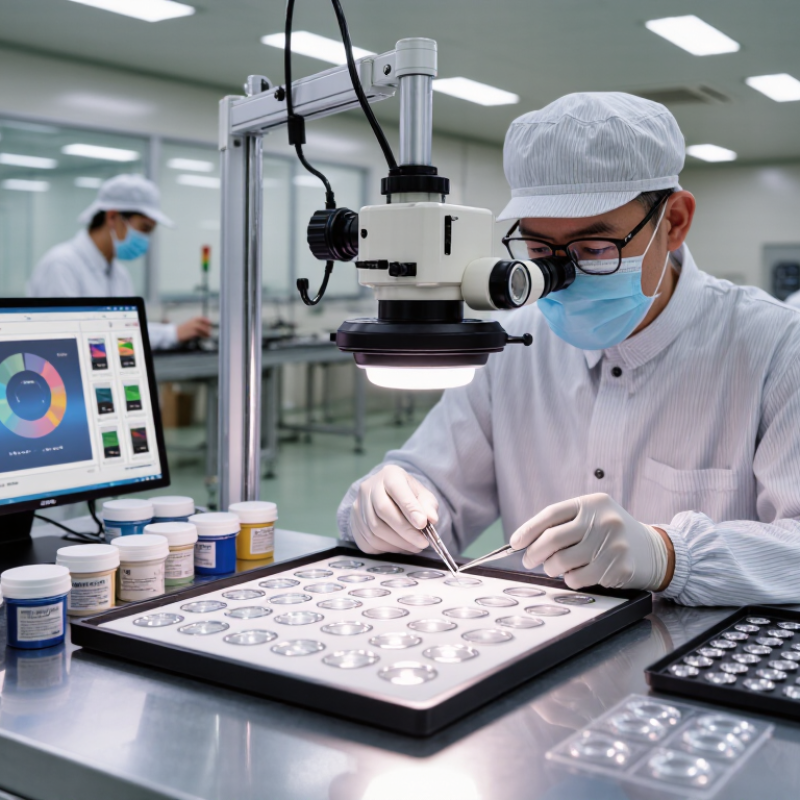
Before comparing factories, write a clear product brief. Specify whether you need daily, monthly, or specialty lenses, and identify the intended wearer and use. Include material, water content, base curve, diameter, power range, and any color or packaging requirements. Small details matter. A sample lens that feels comfortable in one eye may fit differently across a broader user group.
Define the markets where the product will be sold, since applicable requirements can differ. Ask each factory how it supports the relevant product classification, quality-system controls, testing, labeling, and technical documentation. Request current certificates and records, then confirm their scope and validity with a qualified regulatory professional. Do not assume a certificate covers every lens type or destination. That assumption is easy to make.
A useful factory discussion gets specific: Who approves design changes? How are production batches traced? What happens when test results fall outside agreed limits? Ask to review sample inspection records and the process for handling complaints or defects. Vague answers deserve follow-up. It is tempting to focus on price and delivery time, but unclear specifications can create costly revisions later. Leave room in the brief for open questions; not every requirement will be obvious at the start.
A certificate is only useful when its scope matches the factory, site, and contact lens processes you are buying. Check the certificate number, issuing body, expiry date, and audit status. For an ISO 13485 certificate, confirm it covers the relevant manufacturing activities, not just a related office or warehouse. Then compare the factory’s documented procedures with what operators actually do on the production floor. Ask to see batch records, material traceability, cleaning logs, and corrective-action records. Small gaps matter.
The CDC’s 2018 MMWR analysis identified 1,075 reports of contact lens-related corneal infections submitted to the FDA from 2005 to 2015; nearly one in five involved serious eye damage. This is not a factory-failure rate, but it shows why consistent controls deserve scrutiny.
Ask how the factory validates sterilization, monitors environmental conditions, handles complaints, and documents changes to materials or processes. Request recent audit findings and evidence that corrective actions were checked for effectiveness. A polished certificate folder can still hide weak routines. Look closely. Also verify whether the factory can provide the registrations, technical files, and product-specific evidence required in your intended markets. Certification does not, by itself, mean every lens is authorized for sale. One question remains: do the records match the work on the line?
A factory’s stated capacity matters only when it matches the lens types and order volumes you need. Ask how it handles changes in prescription range, material, and production quantity. Can the team explain its molding process, hydration steps, and packaging workflow? Look closely. A line running quickly is not necessarily a line producing consistent lenses.
Compare quality controls at each stage, not just the final inspection. Ask how incoming materials are checked, how production batches are identified, and what happens when a measurement falls outside specification. Request examples of inspection records, with confidential details removed. Clear batch traceability matters. So do documented checks for dimensions, water content, and packaging integrity. These details reveal more than a broad claim of “strict quality.”
A site visit can be useful, but a spotless room does not prove every process is dependable. Ask to see how equipment is calibrated and how staff record deviations. I may be overvaluing tidy paperwork, yet missing records make a factory harder to assess. Compare the answers across suppliers, and note where explanations become vague. One practical question: can the factory show how a sample is linked to its production batch and test results?
When evaluating a contact lens factory, ask for clear material specifications, not just broad claims about comfort. Review the lens material, water content, oxygen permeability, and intended wearing schedule with a qualified technical contact. Request supporting test records and sample lenses from a representative production batch. Look closely at edges, clarity, and packaging seals. Small details matter.
Customization can include lens diameter, base curve, power range, tint, and packaging. Yet every added option may affect tooling, testing, minimum order quantities, or delivery time. Ask which parameters are adjustable and which require a new production setup. Then confirm how changes are documented and checked between batches. Get the limits in writing. A sample can look right while leaving questions about consistency, so ask how the factory verifies repeat orders.
Production capacity needs more than a large monthly output figure. Compare stated capacity with current workload, inspection steps, and realistic lead times. Ask how the factory handles equipment maintenance or a sudden rise in orders. A short pilot run may reveal delays or variation before a larger commitment. It may not reveal everything. No checklist replaces careful review of records, communication, and the factory’s ability to explain its process plainly.
| # | Evaluation area | What to review | Evidence to request | Useful question |
|---|---|---|---|---|
| 1 | Regulatory scope | Confirm that the factory’s quality system and product documentation match the intended lens type and target market. Requirements differ by jurisdiction. | Current quality-system certificates, product-specific technical documentation, and market-specific authorization or listing records, as applicable. | Which legal manufacturer and regulatory pathway apply to this product in each target market? |
| 2 | Material options | Check whether the factory works with the required lens material, such as hydrogel or silicone hydrogel, and can provide relevant material specifications. | Material identity and specification documents, supplier controls, and test reports relevant to the finished lens. | Can you document the material used for each lens model and control changes to its source or formulation? |
| 3 | Oxygen performance | Review oxygen-related data for the finished lens design. Oxygen transmissibility depends on both material permeability and lens thickness, so material claims alone are not enough. | Test methods and results for the relevant lens design and powers, including the conditions under which measurements were made. | Are the oxygen-performance results specific to the finished lens, and how are different powers covered? |
| 4 | Optical and dimensional tolerances | Assess control of parameters such as power, base curve, diameter, center thickness, and, for toric lenses, cylinder and axis. | Product specifications, inspection procedures, calibration records, and representative batch test reports. | Which characteristics are checked for every batch, and how are out-of-specification results handled? |
| 5 | Customization capability | Clarify available ranges and design options, such as sphere, cylinder, axis, addition, tint, packaging, and private-label requirements, where permitted. | Current parameter matrix, approved artwork process, sample specifications, and documented change-control procedure. | Which requested options are already validated, and which would require new development or verification? |
| 6 | Manufacturing process | Understand the production method and controls for molding or machining, hydration, inspection, sterilization, and packaging, as applicable to the product. | Process flow, validation summaries for applicable processes, and records showing routine process monitoring. | Which process steps are validated, and how are process changes assessed before implementation? |
| 7 | Quality management and traceability | Verify documented controls for incoming materials, production records, nonconformities, corrective actions, complaints, and lot traceability. | Quality-system scope, sample batch records, traceability demonstration, and audit findings or corrective-action summaries where available. | Can a finished unit be traced back to its production lot and relevant material records? |
| 8 | Testing and release | Check that testing and release criteria are defined for the product, including applicable physical, optical, microbiological, and packaging checks. | Test plans, method validation or verification records, sample certificates of analysis, and release procedures. | Which tests are performed in-house, which are outsourced, and how are external laboratories qualified? |
| 9 | Production capacity and lead time | Evaluate capacity for the specific lens types, parameter mix, packaging, and order pattern—not just the factory’s total stated output. | Capacity by relevant product family, typical and peak lead times, production planning approach, and contingency arrangements. | What output can you support for our expected SKU mix, and how do seasonal demand or equipment downtime affect delivery? |
| 10 | Samples, audit, and ongoing support | Assess sample quality, communication, complaint handling, change notification, and willingness to support a qualification audit before placing larger orders. | Evaluation samples, sample order records, escalation contacts, complaint procedure, and proposed audit access or schedule. | How are product changes, supply interruptions, and quality complaints communicated and resolved? |
A contact lens factory should communicate with the same precision it uses on the production line. Ask who owns technical questions, how quickly deviations are reported, and whether changes to materials or processes require written approval. Request a sample lot record, a traceability demonstration, and the scope and date of the factory’s quality-system audit. A certificate alone is not enough. Check what it covers.
Costs need the same scrutiny. Compare quotes by including tooling, testing, packaging, minimum order quantities, and freight—not just the unit price. Grand View Research estimated the global contact lens market at USD 20.4 billion in 2023, underscoring the scale of this supply chain. Scale can help, but it does not guarantee dependable service. CDC research published in MMWR found that 99% of surveyed contact lens wearers reported at least one risky lens-care practice. That finding concerns users, not factories; still, it highlights why consistent product quality and clear handling information matter. Ask how the supplier investigates defects, documents corrective actions, and communicates delays. Put response times and quality expectations in writing. A spreadsheet can hide a weak handoff. We sometimes focus too much on price. Check references from customers with similar volumes, then review performance after the first production run.
Suggested evaluation weights for comparing communication, costs, quality, and long-term reliability.
Use these percentages as a suggested 100-point decision framework, not as published market survey results. Verify each criterion with evidence such as regulatory documentation, quality records, written quotations, sample performance, and documented response times. Adjust the weights to fit your product and market requirements.
Specify lens type, intended wearer, material, water content, base curve, diameter, and power range. Add color and packaging needs. Small details matter.
Identify each sales market and ask about product classification, testing, labeling, and technical records. Have a qualified regulatory professional confirm certificate scope and validity. Don’t assume coverage.
Ask who approves design changes, how batches are traced, and what happens when test results miss agreed limits. Request sample inspection and complaint records.
Ask how the factory handles different prescriptions, materials, and order volumes. Have its team explain molding, hydration, and packaging steps. A fast line proves little.
Check incoming materials, batch identification, dimensional measurements, water content, and packaging integrity. Ask for redacted inspection records and calibration examples. Records matter.
No. A clean room is only one detail. Ask how staff record deviations and connect sample lenses with batch tests. I may be overvaluing paperwork, but missing records concern me.
Compare tooling, testing, packaging, minimum order quantities, and freight alongside unit price. A spreadsheet can hide a weak handoff.
Ask how defects are investigated, corrective actions documented, and delays communicated. Put response times and quality expectations in writing. Check similar-volume customer references and review the first production run.
Choosing the right contact lens factory starts with a clear definition of your product, intended users, and applicable compliance requirements. Before comparing suppliers, confirm that their certifications and regulatory documentation are current and relevant to your needs. Then examine how each facility manages production, inspection, traceability, and quality control, since consistent processes help reduce defects and support dependable supply.
Also consider the materials offered, options for customization, and the factory’s ability to meet your expected volumes and timelines. Ask for clear information about pricing, minimum orders, lead times, and communication procedures. A thorough assessment of these factors can help you distinguish a capable manufacturing partner from one that may not suit your plans. Look beyond the initial order and evaluate responsiveness, transparency, and operational reliability to build a productive long-term relationship.